This website
Since 2006 I’ve had a personal website; though I think I’ve spent 10x as much time writing blog engines or themes as I have writing blog posts! It took me a long time to settle on a platform where I feel I can be productive without having to fiddle around too much with content management.
Technology
This hugo powered website is optimised to load lightning fast using:
- a bs4 + tinycss2 based script to inline CSS/JS + tree-shake CSS and substitute class names
- a selenium script to annotate images below the fold for lazy-loading
- html-minifier (which uses clean-css and UglifyJS)
- optipng, jpegoptim and svgo for originals
- webp images
- no frameworks
- caching rules
- a global CDN + static host
I write articles with neovim, validate with VNU validator, spellcheck with typos, lint with eslint, stylelint and proselint. All automatic, of course.
Theme features
- Audio player
- Video player
- Highly responsive blog cards
- Featured star system
- Hero cover images
- HTML and PDF CV generation
- Image scaling and compression (webp/jpg)
- Gallery support
- Tag intersection system
- First-class code embed highlighting/download support
- Active table of contents
- Fully responsive design, with focus on typography and readability
- Horizontal nav bar, panning support for mobile
- Article GUIDs in RSS feed for persistent IDs
- Nix flake for reproducible builds
- Automatic slug (url) synchronisation from title,1 with redirect resolution
- Automatic presentation mode for articles with
presentation: truefront matter
A slug and title are optimising for the same thing, short length and clarity. ↩︎
Post-processor features
- Audio player spectrogram + waveform generation
- Video player automatic poster generation
- Automatic relocation of footnotes to end of section
- Single page bundling, tree shaking, and minification
- Automatic below-the-fold lazy loading
- 400% A+ score on Google Lighthouse
- Automatic image metadata cleaning
- Video/audio codec validation
- Broken link checking (internal always, external on demand)
- Linting of spelling/grammar
- Header linking
- Validation of HTML/CSS/JS
- LaTeX maths rendering
- Automatic inlining of images based on heuristics (SVG and rasterised)
My CV is generated from a YAML template using Hugo and LaTeX with Jinja2. Optimised for file size with ghostscript, cleaned with exiftool and qpdf.
This website and CV are built as a nix flake.2
Phew! That was dense technobabble! ↩︎
History
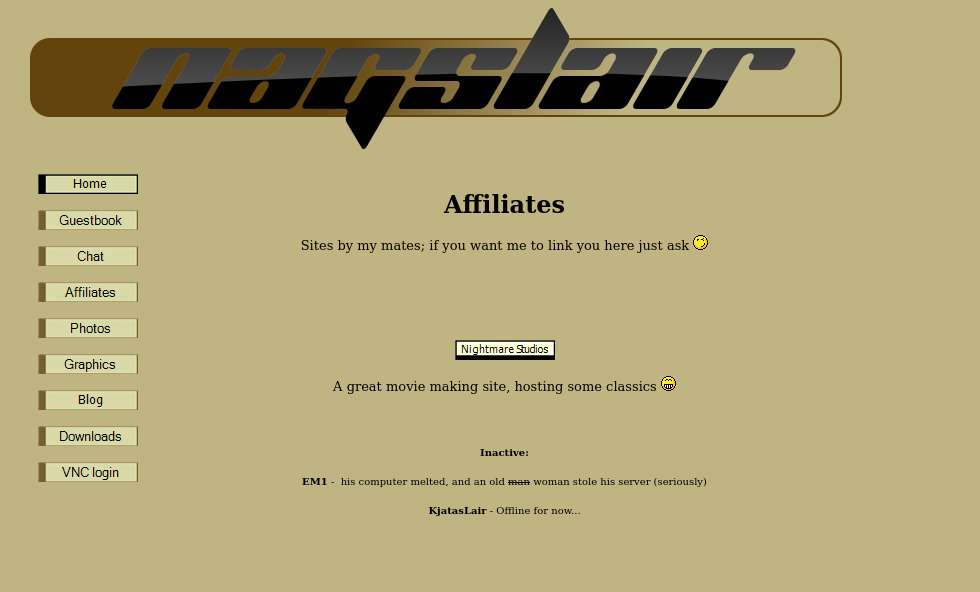
- 2005-2006: Microsoft Frontpage based self-hosted from an ADSL connection with Windows XP + Apache
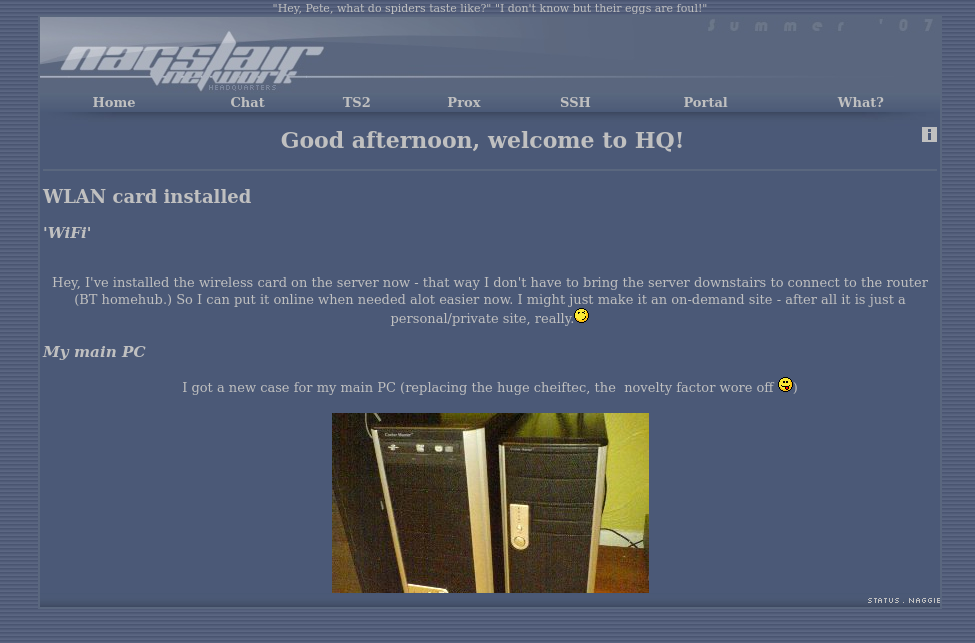
- 2007: Dreamweaver / PHP based custom websites, hosted from ADSL over WiFi with Debian 3.1
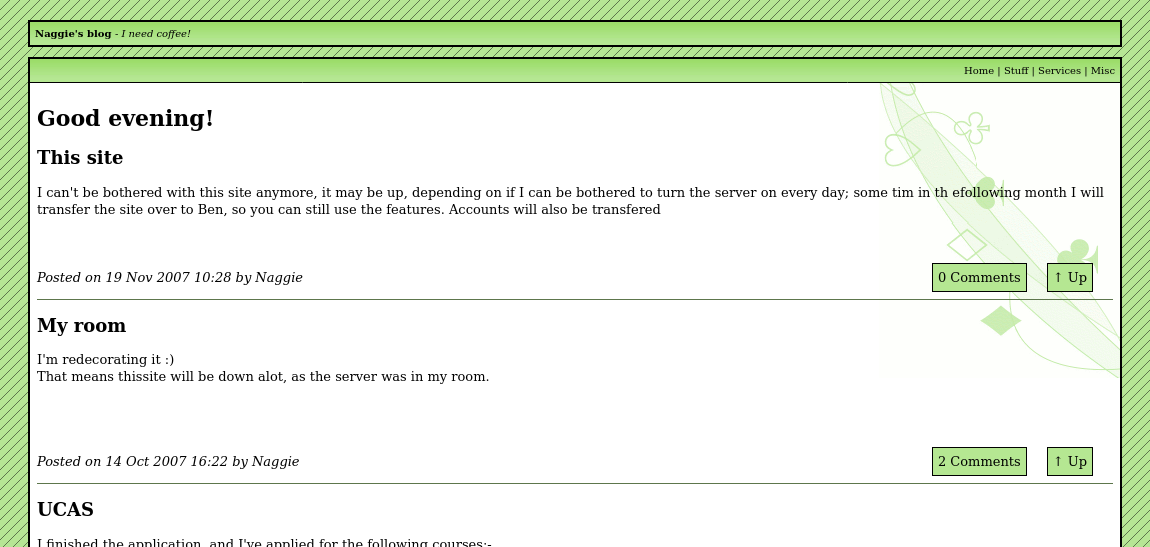
- 2007-2009: PHP based custom websites written with Geany, hosted from ADSL from a Linsys NSLU2 and then a Compaq iPAQ
- 2011-2016: Custom SPA blog engine with client-side markdown parsing. Bad for SEO! Hosted on an Ubuntu VM.
- 2016-2017: Ghost with default theme, hosted on a VM. Supplementary aggregator to mix blog posts from multiple sources.
- 2017-2019: Hugo with default Ananke theme, hosted on a VM
- 2019-2020: Hugo with Mediumish theme, heavily stripped back, hosted on a VM
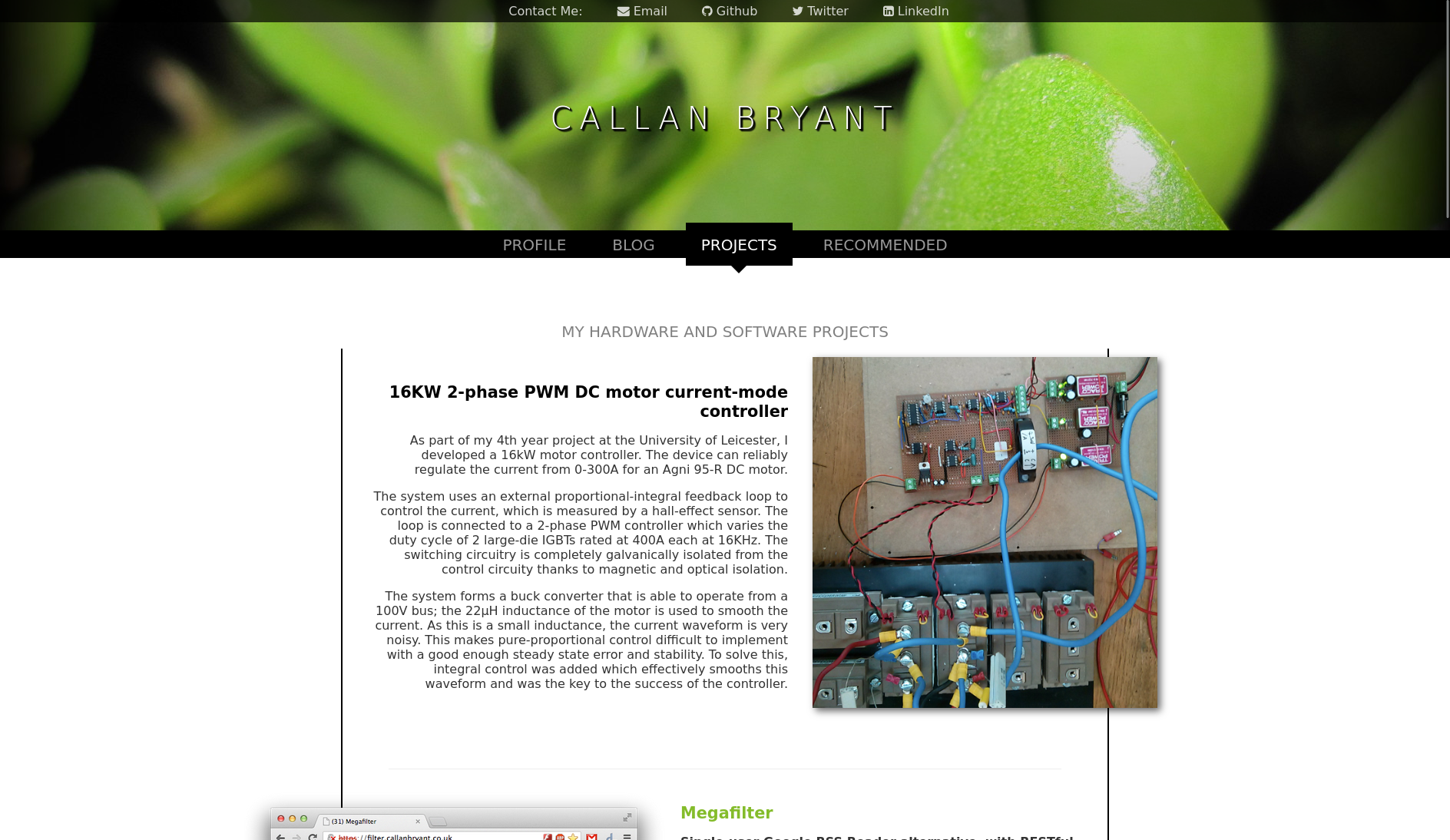
Since 2020, this website is made from scratch with hugo with a focus on typography, quality UX and SEO. Anything off-the-shelf or modified never quite felt right.
How I blog
- Set main headers/sections
- Collect photos and screenshots, often using the favorites feature on iOS
- Automatically insert them into the article with a script3
- Organise images to sections
- Write a section at a time, any order
- I try to tell a story
- I use a lot of multimedia (images, video, audio)4
- I try not to indulge every rabbit hole, instead linking out to other articles
- I keep tangents or comments within footnotes
- I make heavy use of validators and linters to keep the quality high
- I tend to write 5mins to 1hr a day, for a week or so for a typical article5
- I try to make the articles easy to replicate so they’re useful to others
- I follow POSSE principles (publish on your own site, syndicate elsewhere)
Every post represents a Yak shaved, despite attempting not to.
This ended up being the key to actually getting articles written. Handling images is otherwise a pain. I also have a hugo shortcode to handle image resizing, captions and encoding. ↩︎
And my minimal, highly responsive theme to focus on the content ↩︎
That’s how I get all my projects done really – gradually. Sometimes I will dedicate a weekend to get DIY projects done. ↩︎
Projects
Writing a blog post is a great way of finishing a project. It forces me to conclude, limit scope and have something to show for it.
It’s important to accept imperfections in the output – something can be proven ideal in concept without being perfect in practice.
I publish when I feel I have innovated, solved a problem or spent time trying to understand something.
AI Policy
As a software engineer I need to embrace AI. However, I am strongly against AI written articles so do not publish any AI generated articles. All article content on this website is written by me.
Alongside traditional linter style tools like proselint, I use AI on this blog to proofread: correct grammar, spelling and other typos.
Why such a minimal design?
I want to focus on the content, not the design. I don’t want to follow trends, I’d rather own something timeless.
I spend effort on the UX of content delivery, making sure the website performs well on all devices, is consistent with itself and fast to load.
I don’t use stock photos or AI generated imagery, people are sick of that.